

算法理解
本文主要参考Flow Matching for Generative Modeling一文进行理解总结。
Training:
首先,感性上,我们可以将flow-based model对分布的变换理解为:
1)、概率分布可以理解为在高维空间中连续地分布着一些粒子,粒子密度大的地方概率密度大,可以将其建模为一些高斯分布的混合。
2)、空间中分布着速度场v(x,t),这些粒子从一个先验分布p开始,在场中运动,并且在最终时刻稳定,形成我们想要采样的数据分布q。
3)、如果我们把速度场拟合出来,就能得到分布间的变换。
但是,很明显我们无法获得v(x,t)的gt。为此,作者进行了一步十分天才的转换:我们可以将整个变换(速度场)拆分成一些“子变换”(速度场)的加权平均。
具体而言,我们先定义从先验分布到数据分布中每一个数据点的变换(将数据点看成是以该数据点为中心,方差极小的高斯分布),再将这些变换以数据点的概率密度q(x)为权重进行加权。
作者证明了这种拆分是合理的。(theorem 1)
那这种拆分的好处在哪里呢?好处在于我们可以方便地定义先验分布到数据点的变换,比如,完全走直线。
可是我们依然不知道权重啊,怎么加权呢?
作者证明,用神经网络拟合速度场v(x,t)就相当于拟合那些拆开来的“子速度场”(theorem 2)
最终我们就得到了整个的训练过程。
Sampling:
使用成熟的ODE Solver进行采样。
toy demo
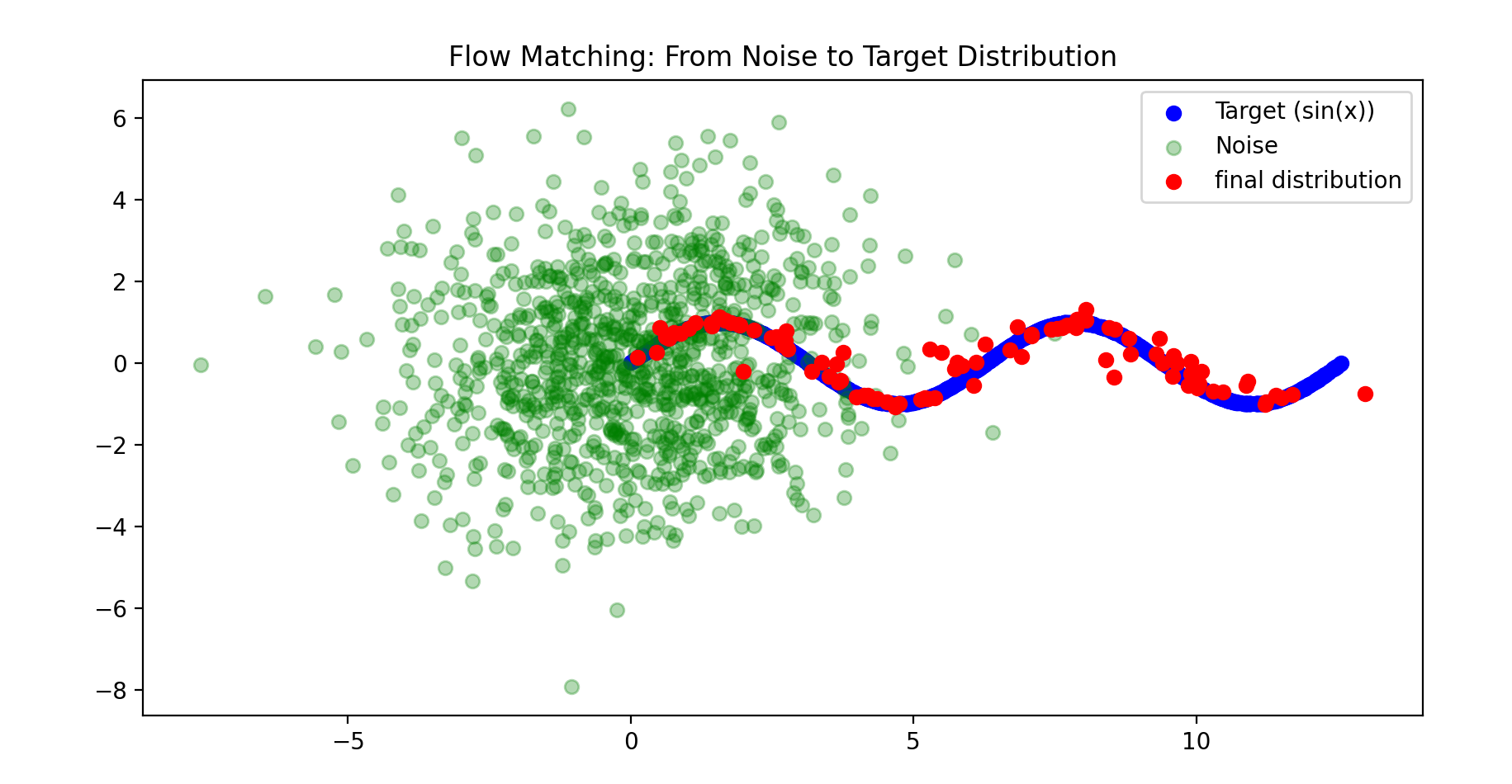
模仿这篇文章做的一个小demo,目标是在二维平面上将一堆高斯噪声中的100个点“挪”到上。 感觉最后效果很不错啊。
import torch
import torch.nn as nn
import matplotlib.pyplot as plt
import numpy as np

# 超参数
dim = 2         # 数据维度(2D点)
num_samples = 1000
num_steps = 50  # ODE求解步数
lr = 1e-3
epochs = 100000

# 目标分布:正弦曲线上的点(x1坐标)
x1_samples = torch.rand(num_samples, 1) * 4 * torch.pi  # 0到4π
y1_samples = torch.sin(x1_samples)                      # y=sin(x)
target_data = torch.cat([x1_samples, y1_samples], dim=1)

# 噪声分布:高斯噪声(x0坐标)
noise_data = torch.randn(num_samples, dim) * 2

class VectorField(nn.Module):
    def __init__(self):
        super().__init__()
        self.net = nn.Sequential(
            nn.Linear(dim + 1, 64),  # 输入维度: x (2) + t (1) = 3
            nn.ReLU(),
            nn.Linear(64, dim)
        )

    def forward(self, x, t):
        # 直接拼接x和t(t的形状需为(batch_size, 1))
        return self.net(torch.cat([x, t], dim=1))

model = VectorField()
optimizer = torch.optim.Adam(model.parameters(), lr=lr)

for epoch in range(epochs):
    # 随机采样噪声点和目标点
    idx = torch.randperm(num_samples)
    x0 = noise_data[idx]  # 起点:噪声
    x1 = target_data[idx] # 终点:正弦曲线

    # 时间t的形状为 (batch_size, 1)
    t = torch.rand(x0.size(0), 1)  # 例如:shape (1000, 1)

    # 线性插值生成中间点
    xt = (1 - t) * x0 + t * x1

    # 模型预测向量场(直接传入t,无需squeeze)
    vt_pred = model(xt, t)  # t的维度保持不变

    # 目标向量场:x1 - x0
    vt_target = x1 - x0

    # 损失函数
    loss = torch.mean((vt_pred - vt_target)**2)

    # 反向传播
    optimizer.zero_grad()
    loss.backward()
    optimizer.step()
    if epoch%1000 ==0:
        print(f"epoch:{epoch}/{epochs},loss:{loss}")

num_of_point=100
x = noise_data[0:num_of_point,:].reshape(-1,2)  # 初始噪声点
#trajectory = torch.empty(num_steps+1,2)
#trajectory[0,:]=x

tag = torch.from_numpy(np.array([1]))
# 数值求解ODE(欧拉法)
t = 0
delta_t = 1 / num_steps
with torch.no_grad():
    for i in range(num_steps):
        vt = model(x, torch.tensor([[t]], dtype=torch.float32).repeat(num_of_point,1))
        t += delta_t
        x = x + vt * delta_t  # x(t+Δt) = x(t) + v(t)Δt
        #trajectory[1+i]=x.reshape(-1,)

#print(trajectory[-1] / (torch.pi / 10 * 4))

# 绘制向量场和生成轨迹
plt.figure(figsize=(10, 5))
plt.scatter(target_data[:,0], target_data[:,1], c='blue', label='Target (sin(x))')
plt.scatter(noise_data[:,0], noise_data[:,1], c='green', alpha=0.3, label='Noise')
plt.scatter(x[:,0], x[:,1], c='red', label='final distribution')
plt.legend()
plt.title("Flow Matching: From Noise to Target Distribution")

plt.show()